Curriculum
Knowing Your Money
Ten modules, taught to women in West Bengal and Maharashtra, in person and online, in Bengali, Hindi and Marathi.
§ 01 · Where it came from
Knowing Your Money began with one person. Shampa looked after the founder from the time he was born, and over the years it became clear how little room the system had left her: no account fully her own, nowhere truly safe for what she managed to save. So he sat with her, over weeks of interviews, and asked the questions he had never thought to ask: where the money went, who decided, what she wished she had been taught. The answers kept pointing to the same gap, a whole layer of knowledge the system assumes everyone has and never hands out. Every one of the ten modules carries a real question, worked out alongside a real person. The curriculum was not adapted from a Western framework. It was built, sentence by sentence, from those interviews.
§ 02 · The ten modules
Click a row to open the longer description.
A bank account in your own name gives you three things: control, proof and safety. Opening one is free under the Jan Dhan Yojana; you only need an Aadhaar card. The module introduces the three questions to ask before handing money to anyone, and how to respond when family or employers pressure you to keep money in their hands.
Ten modules. One textbook in every student’s hand, in her own script, taught in the language of the room.
§ 03 · The textbook
Three editions: Bengali, Hindi and English. Each opens on the resources page.
Knowing Your Money, in the language of the room.
Every student receives the textbook in her own script, typeset for reading aloud, with the key takeaways at the end of every module. All three editions are free to download.
§ 04 · How it is taught
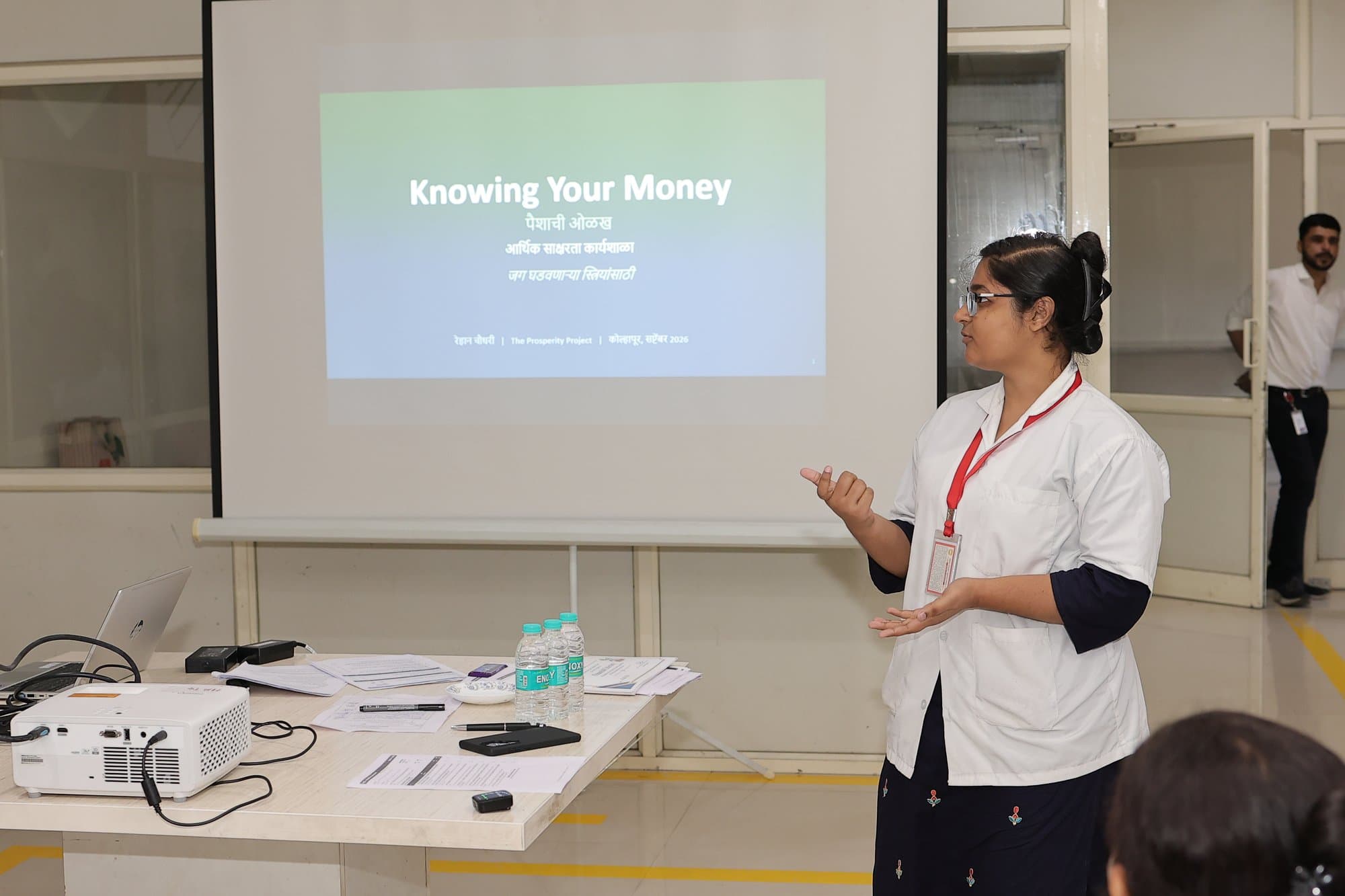
Every module opens with a story about a recurring cast of characters drawn from the original interviews, and we follow their households across the curriculum. Each room is taught in its own language: Bengali with Hindi alongside it in West Bengal, Marathi in Kolhapur, so no student is asked to stretch for language. Each student leaves with the Knowing Your Money textbook in her own script. Short video explainers are being recorded module by module, for households where a daughter or son can sit with their mother and watch together at home. The work travels in the voice it was learned in.
- i.Real interviews shape every module.
- ii.Recurring story characters carry the lessons across the curriculum.
- iii.Every room is taught in its own language.
- iv.Every student keeps the textbook.
- v.Short video explainers, for watching at home.